
Rules To Build By
My rules for building post fire, and the reasoning behind them

It bears repeating that I am not a certified or licensed anything, this is just my personal analysis.
Despite a clear need to build differently than before the fire, I have been surprised how little attention has been paid to fire hardened rebuilding strategies by our community leaders. The primary focus has been on ill-fit “Zone 0” regulations with the occasional mention of “non-combustible” materials. This is still the case nearly a year later.
I have been encouraged by the rate of construction in the Palisades, but surprised by how few are trying something new in terms of fire hardiness. Perhaps this is simply selection bias of early builds.
I believe in leading by example, not lecturing or regulation, and I started this blog with the intent of sharing what I am planning and what eventually gets implemented in this spirit. Over the last year I have been refining my preferred strategies into a list of simple rules. These rules are helpful to me in design as well as in communicating with architects and contractors.
I post them here, and the reasoning behind them, in an “open source” spirit. Perhaps you will find them relevant to your project.
The Rules
Holes are bad - If there is a hole in your house, embers can enter it. The primary example of bad holes are unrestricted attic vents. There are other “holes” to be concerned about, and the risk of ember entry should be mitigated there as well.
Things that can become holes are bad - Most houses have windows. Most windows use glass. While most new houses use tempered glass, they are commonly not impact rated and will shatter when compromised. Additionally most windows in the Palisades are aluminum clad wood. Aluminum melts at 700 C, below the temperature of fire. If you build a house without holes, take steps to make sure a hole doesn’t easily get “installed” in high winds.
BYO Water - Few things stop fire and heat better than water. Assume municipal water will turn off the moment a wildfire starts. You’ll want a backup.
Use non combustible exterior materials - Any material that could come into direct contact with flame or an ember should be non-combustible or Class A fire rated (meaning it won’t spread fire). This applies to the home as well as accessory structures, like a fence or gate.
Use intelligent landscaping - Don’t place plants and mulch in direct contact with your house, especially below floor level. Irrigated trees and hedges are of minimal a concern.
These rules are not instructions on how to build a house that won’t burn, they are rules to help prioritize mitigation strategies that make a house less likely to burn.
The rules do not prescribe solutions, but are a scaffold for mitigation strategies. Each rule may be satisfied through numerous approaches. I will be diving into my preferred solutions in future posts.
If a rule didn’t make the list it’s because I found it does not pass a cost benefit analysis or the situation it protects against is so dire I’m not sure I’d want my home to survive in that case.
The rules themselves are less important than the reasoning behind them. What follows is a condensed explanation of that reasoning.
Risks
When determining how to rebuild, I first wanted to understand the best I could why and how homes burned. Unfortunately, even today, little strong, detailed data is available on how homes burned.
I also don’t believe we will ever get much additional data as most of the evidence — well — burned.
Therefore analysis unfortunately requires the use of first hand experience, anecdotes, and a healthy serving of common sense. I looked at each theory or risk vector and tried to understand the risk it presents and then considered ways it might be mitigated. Here they are in no particular order.
Plants
The risk and corresponding mitigation strategy that is getting the most attention right now is referred to as “Zone 0”. Zone 0 regulations attempt to address the risk of vegetation within 5 feet of a house becoming a fuel / ignition source. It is one of multiple zones around the home with recommendations, but Zone 0 is often used as the umbrella term for these regulations.
A casual tour of the Palisades post fire (which I first took on January 10th) would have most doubting its core tenets.
Looking at my parent’s home, even the maligned Juniper bush that pushed directly against the north (upwind) wall did not catch fire before the house. It also survived the 2000 degree, 8 hour bonfires around it. The fires burned so hot they caused tiles on a fountain 20 feet away to pop off like popcorn, yet this “dangerous” plant survived. All observations better support the theory that the houses burned the trees, not the other way round.


It did not come as a surprise then to learn that there is also existing published research showing, if anything, irrigated vegetation near homes may reduce fire risk.
However, this does not absolve other potentially flammable landscaping near the home, such as plants and mulch. To me, the evidence here is more ambiguous and it is challenging to determine causality. There is important nuance as well, namely how frequently the plants and ground cover are irrigated.
Taken together, I have reached the same conclusion as many of my neighbors: Zone 0 regulations deserve healthy skepticism. They seem tailored to more rural locations or WUI (wild-land urban interface) homes, not dense suburbs like Pacific Palisades.
Consolidating the various signals I have, this is my assessment of landscaping risks as they apply to the non-WUI homes of the Palisades:
Trees and Hedges - very low risk, likely a defense. I have seen no evidence trees serve as a “bridge” for fire in our suburban environment. Not from tree to tree nor from tree to home. This certainly goes against my pre-fire assumptions, but the evidence on the ground is undeniable.
Irrigated Plants - low-medium risk. Irrigated is key here. Almost certainly some plants are greater risk than others. Plants near homes were of course burned, but which burned which?
Mulch / Bark - medium risk. While often moist, the very fact that this is ground cover guarantees that embers will come into contact with it. Often much is pressed up against the home, often below where siding starts, a vulnerable location. This is largely based on my speculation and some artificial test results. Note: Most artificial tests I’ve seen do not simulate the use of irrigation and have obvious bias.
Vents
Attic vents or crawl space vents are often cited as an entry point for wind driven embers. In various meetings, I’ve heard reputable community leaders and fire experts repeat the claim that 80-90% of homes burned “from the inside out”. Not the highest grade of evidence, but the reality on the ground supports the claim. For stucco homes, a very common sight is the cementitious “shell” still standing with the wood framing burned from within. This may just show the home burned from back to front, but this result was common enough to warrant attention.
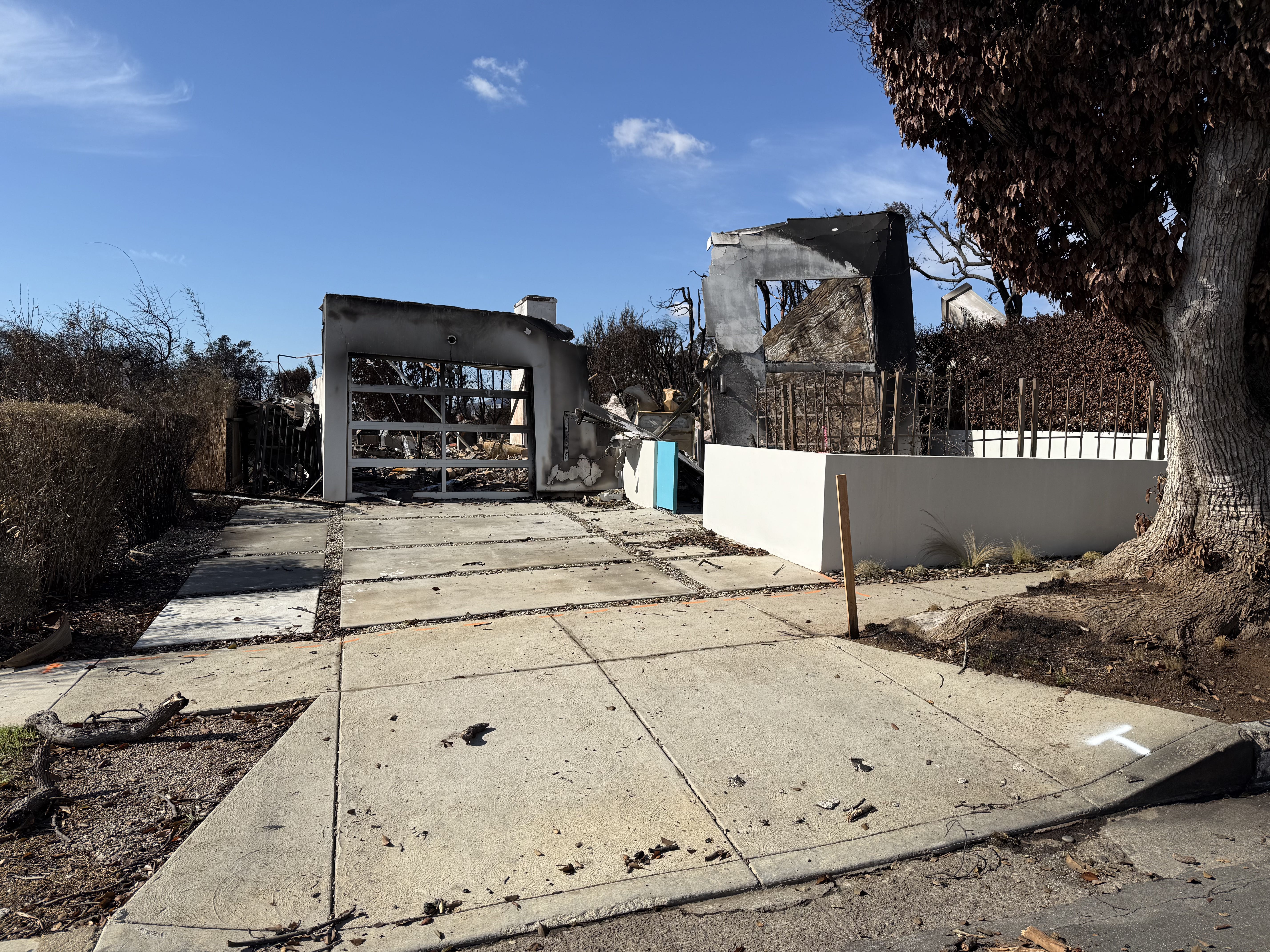
Videos from the night repeatedly showed showers of embers swarming the skies and streets. Many houses had unprotected vented attics. Even a now famous surviving home in the Alphabet Streets surrounded by destruction was built to passive house standards, with no attic vents (by my understanding). It does not seem like a leap to conclude these openings are a serious risk to any home.
Attic/crawl space vents - highest possible risk
Other vents - medium-high risk, depending on what they are tied in to
Windows
Every house has windows. Most commonly they are glazed with glass and made of materials that are flammable or have a low melting point (wood, aluminum, vinyl).
The only related hard evidence I have here is the puddles of melted glass and aluminum anyone effected found around their homes. If your house is directly challenged by fire it seems windows can only hold out for so long.
Window failure due to heat becomes one of the primary risks when a home is burning next door.
I have heard other stories of surviving homes with broken windows, either by an apparent impact or brute force of the wind. To me it is a miracle these homes survived, however most homes that survived near areas of destruction I observed had their windows in tact.
It perhaps goes without saying that any future high risk wildfire event will be accompanied by high wind.
I believe that for most homes, high wind presents a serious risk to the integrity of windows. Only one window needs to break for a catastrophic outcome. While I would entertain arguments this is alarmist, it is the catastrophic failure mode of standard windows that makes them high risk to me. Windows won’t break a little. They are either part of the buildings envelope OR (when broken) a giant hole for embers.
Standard windows/glass - high risk.
Windows with low melting point materials - high risk with neighboring fire
Combustible Materials
Perhaps the most obvious risk of all? If you don’t want your house to burn, don’t build it out of stuff that burns! But let’s not let this seemingly obvious statement stop us from being thoughtful.
My house was built with 98% non-combustible siding, soffit covers, and roofing. Most new homes were, but they didn’t fare much better than older more combustible homes. It’s possible the siding held up fine and it was the vents or windows (as I suspect). But maybe it was also my facia boards that were painted redwood that ignited from radiant heat? Or maybe the exterior storage doors made of a composite material?
Because so much burned, it is difficult to forensically/statistically determine how often combustible materials were the difference between a home surviving and not, but logically assigning this anything other than high risk just seems foolish.
Combustible exterior materials - high risk
Lack of Water
Before the fire, our primary reservoir was left empty. The hydrants produced inadequate pressure - seemingly right away. Cascading activation of interior fire sprinklers stole pressure, vaporized homes gushed water from their liberated water mains.
As I toured the destruction on Friday, what struck me more than anything else was how there was water everywhere.
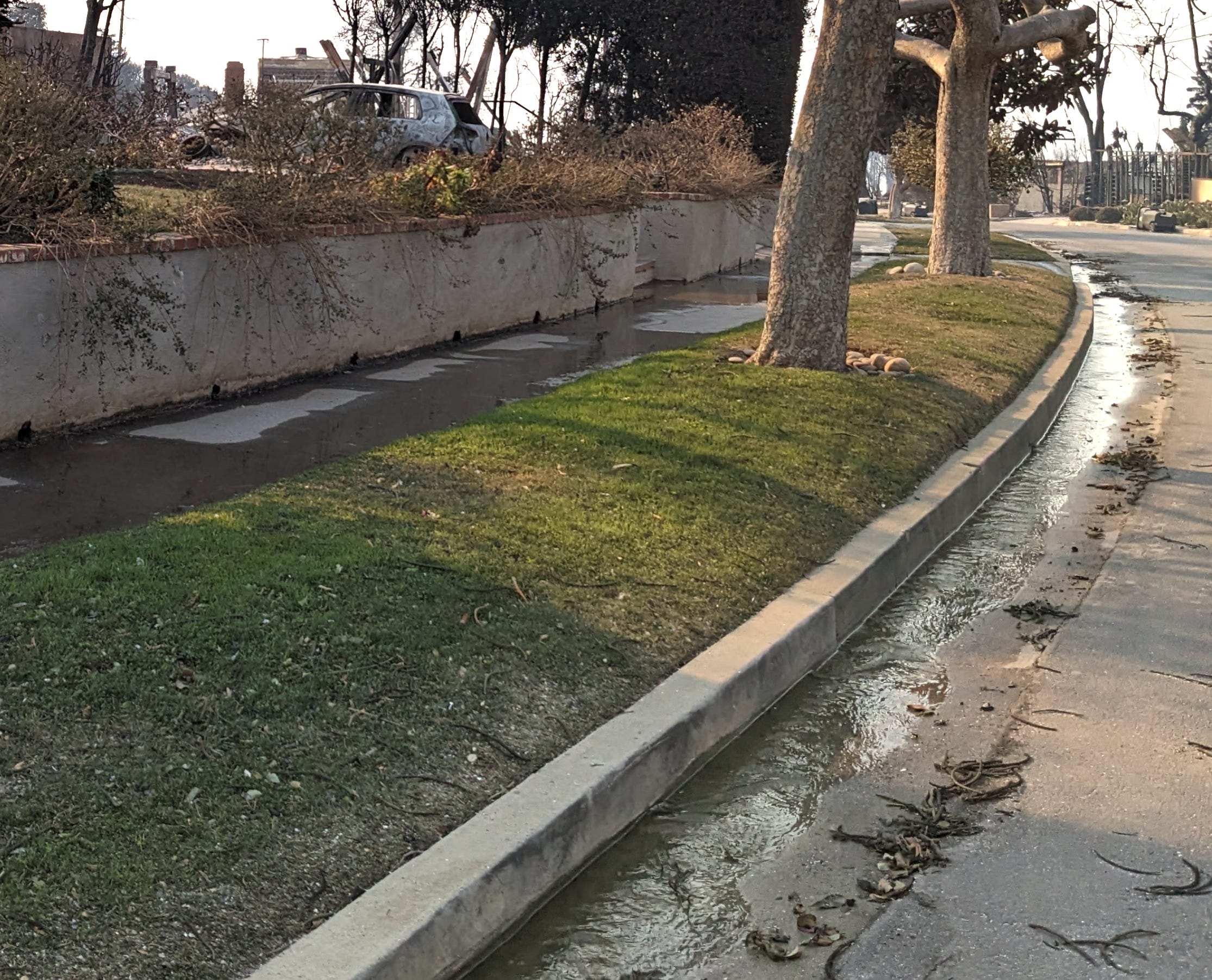
The number of issues with our water system, and its management, are overwhelming. I hope we pursue every possible improvement (and resignation). However, any sober risk analysis must assume the inescapable truth that in the next serious wildfire, municipal water cannot be relied upon.
I never imagined I would need to make this argument but here we are: Water is good at stopping fire. Yes, I’ve seen how spraying a home engulfed with flames with a fire hose is ineffective, but that is not the primary use of water to fight fire in my view. The primary way water reduces the risk of losing your home is in preventing the spread of fire. Wet things do not burn easily.
Furthermore water spray cools things down and increases humidity locally. If an adjacent house is in flames, water is your last line of defense as it can keep your home cool enough to avoid parts of the building envelope from melting or even spontaneously igniting from radiant heat.
If you do not have any access to water on or near your property it also prevents firefighters (public or private) from defending their position, making them more likely to leave prematurely. For this reason, lack of water is of serious concern.
Lack of water - high risk
Analysis
For each risk there are often numerous ways to mitigate. I could go into each possible solution I know, but as I stated at the outset, the rules are more about identifying and prioritizing risks rather than prescribing solutions. I do have preferred solutions, but focusing on the problems is most effective. In future posts I will explain my reasoning behind my chosen solutions which better take into account considerations of cost, appearance, and achievability. For now I want to stay focused on how I distilled the identified risks into rules.
As you’ve already read the rules it will come as no shock that I believe the first risk that must be mitigated is vents! No holes! This is in-fact easier said than done, but it’s far from difficult and is inexpensive. I will be sharing my strategy in future posts but note that simply closing attic vents can have catastrophic consequences due to moisture accumulation. Many think attic vents (or crawl space vents) are about keeping a home cool, but their primary function is managing water vapor (which can lead to mold). Interrogate your contractor as to how they plan to manage attic moisture if you decide to remove vents. Reference IRC 806.5.
I prioritize vent closure above water, vegetation strategy, or non-combustible materials without equivocation because this vulnerability exposes my home to being ignited from afar and with no obvious visible indicator that my house is under imminent threat. Additionally, once the fire ignites from within the attic, the home will almost certainly be a total loss. If anything, placing this at #1 understates its importance — it feels like it should be on a different list alongside having a roof, walls, and interior plumbing.
Moving on to the the next priority, multiple risks start to look broadly similar. If I could only mitigate 1 or 2 additional threats, the choice might be difficult, but stopping there strains belief. So, instead I look at the risks in combination, as that is exactly how they will threaten my home.
The sensible “second course” of mitigation strategies would seem to be a mix of non-combustible materials, sensible landscaping choices, and fire-appropriate windows. All three are similarly low cost and mitigate a significant risk.
However, you will find that in my ranking, I break up this set of strategies with my desire to “bring my own water”. Over the last several months this rule has crept up the order. Let me explain why.
Let’s first consider how having water interacts with other risks:
If a spot fire starts on a poorly placed plant, you can put water on it.
If a fire starts on a combustible section of cladding, you can put water on it.
If a neighboring home is on fire, with additional systems, you can keep your house cool to avoid window melting.
You might be asking, “well, wouldn’t it be better if you didn’t have to put out those fires!?” I agree with you 100%. I seem to be presenting some sort of paradoxical argument! I could never imagine going to the lengths of having my own water storage solution and not ensuring the home is also hardened in other ways. So why put water first? Here is why: how do I know my house is fire hardened, and to what degree? Will I attempt to set it on fire as a test?
It is very difficult to test (or re-test) non-combustible materials or planting strategies. This is why I prioritize water availability over these simpler mitigation strategies. It increases the overall fault-tolerance of nearly all other strategies.
As an aside, this is also why I specify “bring your own water” and not any fire suppression system because regularly testing the foam or flame retardant systems is impractical. Additionally, foams and flame retardants don’t mitigate heat. I’ll discuss this more when I elaborate on my planned water backup solution in a future post.
Despite the fault tolerance it brings, water cannot prevent glass from breaking from an impact. This forces me to delineate the “new holes” strategy from the vegetation and materials strategies in how they interact with water. If window glass is compromised, water cannot make it more fault tolerant!
In other words, a home’s envelope (walls, roof, and windows) must protect the inside in order for water to be useful to protect the outside.
While this reasoning alone justifies the order in my view, it is also worth considering that if you have water available it enables more strategies that are outside the building scope: Neighborhood volunteer firefighters, private fire fighters, and even increasing the odds public firefighters stay near your house. But these strategies are also still compromised by broken windows.
In conclusion: Protect against new holes, water comes next.
Looking at the final two risks, I (perhaps obviously) would choose to mitigate the materials risk first for the simple reason that a home built with combustible materials can still ignite even with no plants nearby. Clad your house with stuff that won’t burn, then smartly design landscaping to avoid unnecessarily stress testing it.
So this leaves us with our final order: No holes, no new holes, water, good materials, and smart landscaping. Each one increases the effectiveness of the one after it. I believe together they produce a fire resistant, and defendable home.
At this point you might be thinking, “why did he obsesses over the order of the rules if he’s saying he’ll follow all of them anyway?!” The order matters to me because it requires an explanation of the reasoning. If you can’t understand why you are following a strategy you will be more likely to end up with a solution that completely defeats the point.
Care for an example? The Santa Ynez reservoir was built in response to the Bel-Air fire when hydrants ran dry. Some sixty years later the reservoir cover formed a tear. We drained the reservoir due to modern drinking water standards. Then the town burned down. Somewhere along the way we forgot our full reasoning for having the reservoir. The cover was for meeting drinking water standards, but the reservoir was for fighting fire.
When plans change (as they frequently do when building a house), make sure the change does not compromise the original design intent.
With your house hole-free and fire hardened — with water on site — you still might not feel like you’ve done enough. I personally will be doing more, but that might have more to do with my personality and resources than any real need. If most houses followed these rules, I’d wager heavily the Palisades would never burn again.
Over the coming months and years, I look forward to sharing the details of how I plan to implement these “rules” for my houses and also the steps I take that will go beyond. While I will not employ all techniques on all the homes, they will include most of the following:
Unvented attics
Metal roofing
Impact rated windows
Non-combustible cladding
Exterior fire-proof (mineral wool) insulation (roof and or wall)
Battery backup
Underground water storage
Rooftop and eve sprinkler systems
Pump systems
Intelligent landscaping
Once again, this is not advice. I am sharing this in an “open source” spirit in the hopes that it inspires others to take a closer look at their fire hardening strategy, or at least have a conversation.
I believe we have found ourselves in this awful position because of a lack of vigilance. To reclaim it we must rely on our own judgement, and do the necessary work to validate it. That starts with building our own homes.